

AVCs For Irish Savers
MWM_Editor
Could AVCs help you get more from your pension?
How Additional Voluntary Contributions work, the tax relief available, and illustrative examples of what they could mean for your retirement savings.
Additional Voluntary Contributions (AVCs) are extra contributions you can make towards your pension, in addition to the regular contributions you already make to an occupational pension scheme. For many employees and public servants, they can be a tax-efficient way of increasing their retirement savings.
The key benefit: Income Tax relief at your marginal rate
AVC contributions can qualify for Income Tax relief at your marginal rate, subject to Revenue limits. For example, if you pay Income Tax at 40%, a €100 AVC contribution on which full tax relief is available could have a net cost of €60. For someone paying Income Tax at 20%, the equivalent net cost could be €80. Income Tax relief does not extend to USC or PRSI.
Investment returns within the pension fund generally accumulate free of tax while they remain invested, giving pension saving an important tax advantage compared with many forms of personal investment.
Who can contribute, and how much
If you’re a member of an occupational pension scheme, whether in the private or public sector, you may be able to make Additional Voluntary Contributions to increase your retirement savings. AVCs may be made through your existing scheme or, depending on the circumstances, through a PRSA used for AVC purposes. If your occupational pension scheme doesn’t provide an AVC facility, your employer must make access to a standard PRSA available for AVC purposes. This means that being unable to make AVCs directly to your employer’s scheme doesn’t necessarily prevent you from making additional pension contributions.
The amount of your pension contributions that can qualify for Income Tax relief depends on your age and earnings. The limits apply to your own pension contributions in total, including your normal employee contributions and any AVCs.
- Under age 30: 15%
- Age 30–39: 20%
- Age 40–49: 25%
- Age 50–54: 30%
- Age 55–59: 35%
- Age 60 or over: 40%
These percentages apply to earnings up to €115,000 a year. Your normal employee pension contributions and AVCs both count towards your personal limit. Employer contributions are not included when calculating this limit.
For example: if you’re 45 and earn €80,000 a year, up to 25% of your earnings, or €20,000, may qualify for Income Tax relief on pension contributions. If you’re already contributing €8,000 personally through your employer’s pension scheme, this could leave scope for a further €12,000 AVC to qualify for relief, subject to your individual circumstances.
What happens at retirement
AVCs form part of your overall retirement benefits and are subject to the rules applying to your pension arrangement. Depending on the type of arrangement and your circumstances, you may be able to take part of your retirement benefits as a lump sum, with the balance used to provide retirement income or invested through an appropriate retirement arrangement.
Under current tax rules, the first €200,000 of retirement lump sums received over your lifetime is tax-free. The portion between €200,000 and €500,000 is subject to Income Tax at 20%, while amounts above €500,000 are taxed at the higher rate.
The remaining pension benefits may, depending on the arrangement and your circumstances, be used to provide retirement income, for example through an annuity or an Approved Retirement Fund (ARF). Tax generally applies when taxable pension income or withdrawals are received.
Unlike ordinary savings, pension funds are intended for retirement and access is restricted. This makes AVCs more appropriate for money you can afford to set aside for the longer term.
A worked example: AVC vs personal saving
Say you’re 40, a higher-rate (40%) taxpayer, and you can comfortably give up €300 a month from your take-home pay. You have two options:
- Put it in a regular savings or investment account: you invest €300 a month from your take-home pay, growing at an assumed average annual return of 5%.
- Put it into an AVC instead: assuming the contribution qualifies for Income Tax relief at 40%, the same €300 net cost allows you to contribute €500 a month gross to your pension (€500 less 40% Income Tax relief = €300). Investment returns then accumulate tax-free within the pension fund.
For illustration, we will assume both investments achieve an average annual return of 5%, compounded daily, with contributions made monthly:
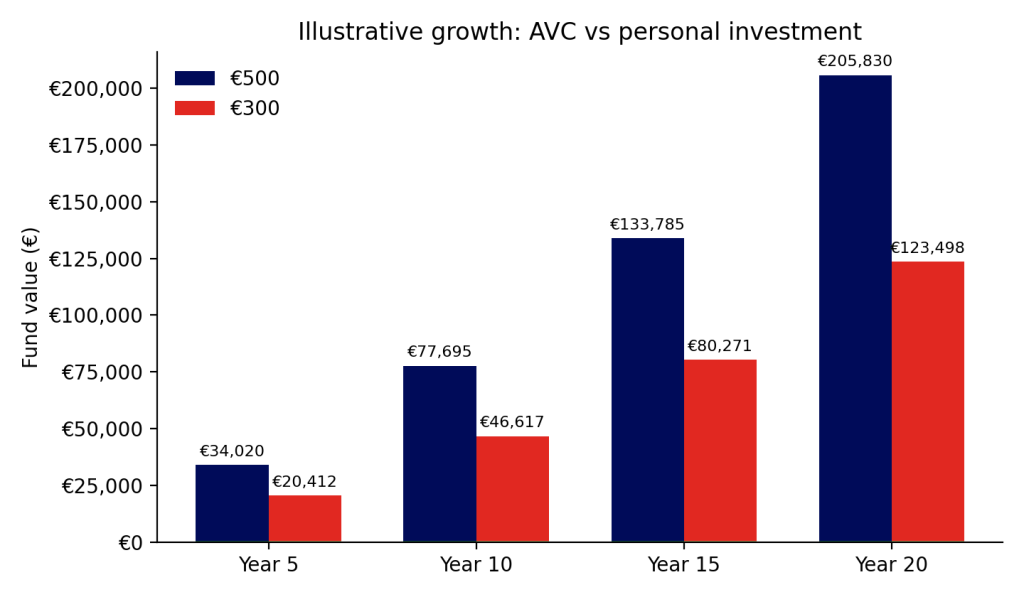
Method: 5% nominal annual return, compounded daily → effective monthly rate ≈0.4176%, applied to an ordinary annuity of monthly contributions.
After 20 years, the AVC fund would be approximately €205,830, compared with approximately €123,498 in the personal investment, a difference of around €82,300 in the accumulated fund values. The difference arises because the Income Tax relief allows €500 to be invested in the AVC for the same assumed €300 reduction in take-home pay.
In practice, an ordinary savings or investment account is also taxed along the way, depending on what it’s held in: a deposit account loses 33% DIRT annually on the interest earned; a pooled fund, ETF, or life-assurance investment policy falls under the exit tax regime — reduced from 41% to 38% with effect from 1 January 2026 — charged on actual encashment or via a “deemed disposal” every 8 years, not annually; and direct shares are subject to 33% CGT, but only when you actually sell, with no deemed disposal.
This comparison deliberately does not allow for tax on returns within the personal investment. Depending on how personal savings or investments are held, tax may be expected to reduce the return achieved outside a pension. Equally, the AVC figure represents the value of the pension fund before any tax that may arise when retirement benefits are taken. Actual investment returns will vary, and charges have not been included in this illustration. Unlike personally held savings and investments, investment returns within a pension fund accumulate tax-free while invested. Tax may arise when benefits are taken at retirement: under current rules, the first €200,000 of retirement lump sums received over your lifetime is tax-free, with the next €300,000 taxed at 20%. Any remaining benefits are taxed according to how they are taken, for example as pension income or withdrawals from an ARF.
Starting early: a 32-year-old with an executive pension
Consider someone aged 32, earning €50,000 a year and in an Executive Pension Scheme, with an employee contribution of 4% of salary and a matching 4% employer contribution. They are considering adding a further 10% of salary as an AVC.
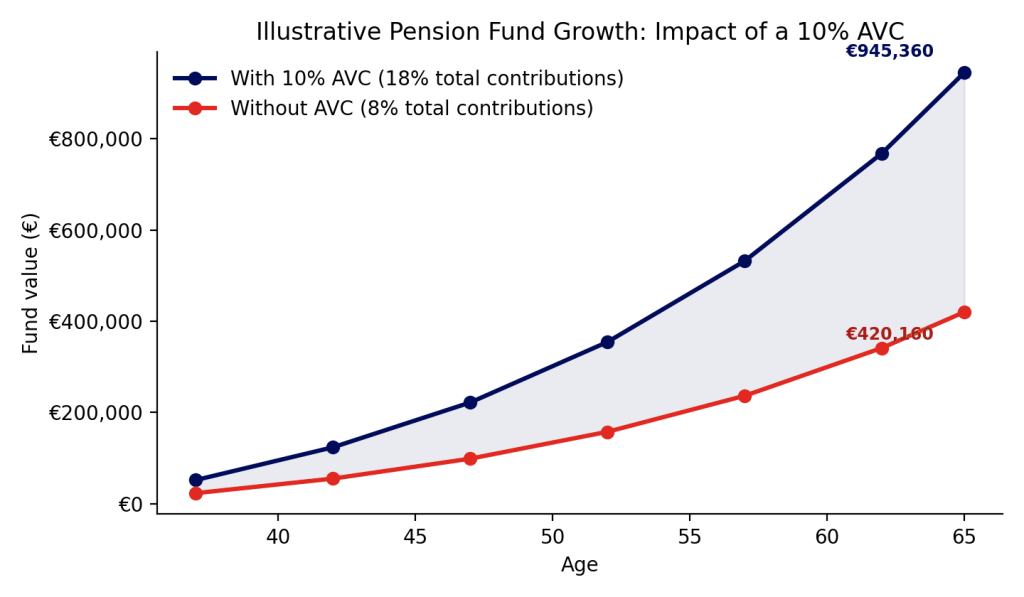
Illustration assumes salary growth of 2% a year and investment growth of 5% a year to age 65. Actual investment returns and salary increases will vary. Charges and taxation of retirement benefits are not reflected.
By age 65:
- Without the AVC (8% total contributions): fund of approximately €420,160
- With the 10% AVC (18% total contributions): fund of approximately €945,360
- Additional fund attributable to the 10% AVC: approximately €525,200
The example illustrates the potential benefit of starting AVCs early. Contributions made in your 30s have much longer to benefit from investment growth and compounding than contributions made closer to retirement.
AVC contributions may also qualify for Income Tax relief, subject to Revenue limits and your individual tax circumstances. At age 32, personal pension contributions of up to 20% of relevant earnings can currently qualify for Income Tax relief. In this example, the individual’s personal contributions, comprising the 4% employee contribution and 10% AVC, amount to 14% of salary for this purpose. Employer contributions do not count towards the employee’s age-related percentage limit.
Examples for higher earners
The potential contribution amounts can be greater for higher earners and for people in older age brackets, as the percentage of earnings eligible for Income Tax relief increases with age, subject to Revenue limits and individual circumstances.
Example 1 — Maximising headroom near the earnings cap
A consultant or senior manager, age 50, earning €115,000 (the current earnings cap for pension tax relief purposes on personal contributions), can qualify for Income Tax relief on personal pension contributions of up to 30% of earnings, or €34,500 a year. If their personal contribution to their scheme is 10% of salary (€11,500), they could have scope for a further €23,000 a year in AVCs to qualify for Income Tax relief. If that full €23,000 contribution qualifies for Income Tax relief at 40%, its net cost would be €13,800.
Growing at 5% annually over 10 years to retirement at 60:
- Gross pot after 10 years: €297,750
- Total net cost over those 10 years: €138,000
Example 2 — Using unused contribution headroom
A 58-year-old identifies that they have unused pension contribution headroom for the previous tax year and decides to make a once-off AVC of €30,000. Provided the contribution is made within the required timeframe and satisfies the relevant conditions, they may be able to elect to claim the Income Tax relief against the previous tax year. If that full €30,000 contribution qualifies for Income Tax relief at 40%, its net cost would be €18,000. Assuming investment growth of 5% a year, the €30,000 contribution could grow further over the period to retirement, for example to just over €38,000 after 5 years.
Making the most of your options
AVCs can be a valuable way to increase retirement savings, particularly where you have scope within the Revenue contribution limits and can afford to set additional money aside for the longer term.
The amount that is appropriate will depend on your age, earnings, existing pension contributions, tax position and wider financial circumstances. For some people, regular AVCs may be suitable; for others, a once-off contribution may be worth considering.
The starting point is to establish how much scope you have for additional contributions, the Income Tax relief potentially available, and how an AVC fits within your overall retirement plan.
This article is for general information only and does not constitute financial or tax advice. Figures are illustrative, based on assumed contribution and growth rates, and are not a reliable guide to future performance. Tax treatment depends on individual circumstances and current Revenue rules, which may change. Speak with a financial advisor or your pension provider before making contribution decisions.