
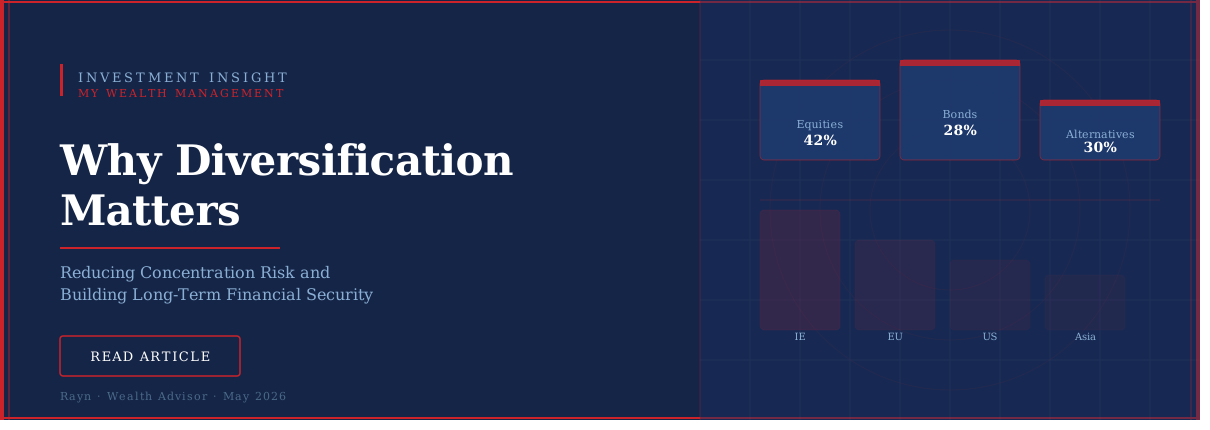
Why Diversification Matters
MWM_Editor
Why Diversification Matters: Reducing Concentration Risk and Building Long-Term Financial Security
Many professionals accumulate significant wealth through employer share schemes and without realising it, a growing proportion of their financial future becomes tied to a single company. That is a risk worth taking seriously.
Equity awards, stock options, and bonus shares are genuinely powerful tools for wealth creation. But they can also create what we call concentration risk where a disproportionate share of your net worth depends on the fortunes of one organisation. These incentives are sometimes described as golden handcuffs: compelling enough to encourage long tenure, yet quietly increasing your financial dependence on a single corporate outcome.
This article explores how that risk accumulates, why diversification is a cornerstone of sound long-term investing, and the practical steps you can take to build a more resilient portfolio.
The hidden risk of concentration
Holding a large position in a single stock, particularly your employer’s, introduces company-specific risk. Unlike a diversified portfolio, where exposure is spread across many holdings, a concentrated position leaves your wealth highly sensitive to events in one organisation.
Concentrated portfolio risks
Earnings disappointments or profit warnings
Regulatory or policy changes
Sector-wide downturns or disruption
Leadership changes or strategic missteps
Competitive or technological shifts
Diversified portfolio benefits
Risk spread across multiple companies
Exposure across industry sectors
Geographic balance built in
Mix of equities, bonds and alternatives
Smoother returns over time
How concentration builds, often without realising
Concentration risk rarely stems from a single deliberate decision. More often it accumulates gradually through years of participation in employer equity schemes. Annual bonus shares vest and are retained, stock options are exercised, restricted stock units accumulate. Each allocation, viewed in isolation, appears manageable. Over a decade, the picture changes considerably.
Typical exposure range
€100k to €500k
Single stock concentration through equity awards
The core challenge
Dual risk
Both income and wealth tied to one employer
The solution
Phased plan
Structured, gradual rebalancing over time
Most investors would not choose to place €100,000 to €500,000 into a single stock. Yet through the natural progression of equity compensation, many professionals find themselves at exactly that level of exposure with a substantial portion of their wealth dependent on one company’s performance.
The dual risk: income and wealth in the same place
For many professionals, the greater concern is not just portfolio concentration. It is the overlap between employment income and investment exposure. Your salary, bonus, and career trajectory are already tied to your employer. If a significant portion of your investment wealth is also held in that same company, you carry a dual exposure that can compound quickly during periods of difficulty.
A company downturn could affect both your earnings and your investment value simultaneously, precisely when financial resilience matters most. Diversification addresses this directly by reducing reliance on any one corporate outcome across both streams of your financial life.
The case for diversification
Diversification is not about losing confidence in your employer or walking away from growth potential. It is about ensuring your financial future is not dependent on a single outcome, however strong that company may appear today.
- ✓Reduced portfolio volatility over market cycles
- ✓Improved risk-adjusted returns over the long term
- ✓Greater resilience to company and sector specific shocks
- ✓More consistent progress toward long-term financial goals
Spreading exposure across multiple companies, industry sectors, geographic regions, and asset classes including equities, bonds, and alternatives helps smooth returns and reduces the impact of any one underperforming position.
Current market context: a moment worth considering
Equity markets have seen strong performance in recent periods, with many technology and growth-oriented stocks trading near elevated levels relative to historical averages. Periods of strong performance are often a good time to step back and review existing exposures, not in reaction to fear, but as part of sound portfolio governance.
Rebalancing does not need to happen all at once. A phased approach can help manage timing risk while steadily reducing concentration, giving you control over the process without needing to call the market perfectly.
Taking a practical approach
Reducing concentration is not about abandoning what has served you well. It is about strengthening financial resilience going forward. Practical steps typically include:
- 1Gradually selling vested shares over a structured timeframe
- 2Reinvesting proceeds into diversified investment portfolios
- 3Aligning investments with clearly defined long-term financial objectives
- 4Implementing a disciplined rebalancing plan with defined review points
This approach allows you to reduce risk in a measured way, while still maintaining exposure to future growth potential where appropriate.
If you have accumulated a meaningful position in employer shares, it may be worth reviewing whether your current level of exposure remains aligned with your broader financial goals and risk tolerance. We would welcome the conversation.
