Market Update
Financial Planning | Investments | Pensions | Protection
Short Term Volatility Impacts:
Energy Shock and Market Repricing as Gulf Tensions Intensify
How have markets reacted?
- Oil prices rose sharply again over last weekend, they are now up around 45% since the conflict began, with the price of Crude oil hitting $120 a barrel at one stage on Monday morning before falling back to $104 per barrel by lunchtime, nevertheless oil is now up 70% in 2026.
- Natural gas prices also jumped reflecting temporary shutdowns of energy production across the Gulf region highlighting the region’s importance to global energy markets. European gas prices are up 82% in March alone.
- Equity markets fell further on Monday morning with economies with a perceived reliance on oil from the Middle East hit hardest. By lunchtime on Monday European equities had fallen 8.4% in March, while Emerging, Japanese and UK have also fallen significantly over the same period. US equity market futures are also softer, falling 1% on Monday.
- With investors factoring in the possibility of prolonged higher energy prices, markets are now concerned about the longer-term impact on inflation and growth. With the possibility of higher inflation, interest rate expectations have risen with markets now pricing in rate rises in 2026 in both the UK and Europe, this has led government bond yields to rise across many countries.
MyWealthManagement’s current view:
- The abrupt escalation has substantially increased uncertainty. If the war ends very soon, the impact on global growth and inflation should be minimal and asset prices may quickly revert toward pre-war levels. If it persists modestly longer, the effects are likely to be a moderate drag on growth this year and a modest, temporary uplift in inflation.
- In this scenario, risk-asset weakness should prove temporary and central banks would likely look through the supply-side shock, albeit with some delay in their policy paths.
- However, if the conflict becomes a multi-month event, the growth impact would be more significant (global growth potentially reduced by ~0.5 per cent) and the inflation shock larger and more persistent. This would be the most adverse outcome for risk assets, with prolonged uncertainty and weakening growth expectations. Should inflation expectations become de-anchored, central banks such as the European Central Bank and the Bank of England might be forced to hike further, though any subsequent recession would likely push them toward easing later.
Scores on the doors in the past week
- The S&P 500 closed down -2.02%
- The NASDAQ 100 shed -1.24%
- The STOXX 600 in Europe sold off -5.55%
I suspect that many investors would be surprised to know that despite the headlines of the last week, the actual 12-month numbers are:
- The S&P 500 is up 16.81%
- The NASDAQ is up 23.03%
- The STOXX 600 is up 8.19%
Asian markets who are also heavily dependent on energy imports weren’t spared with EM equity indices closing lower across the board.
In the US, energy prices also weighed on sentiment but, given its position as a net energy exporter, US equity markets were shielded from the worst of the price action.
Manufacturing and Services PMIs (Purchasing Managers’ Index) came in positive, but both surveys continued to reflect building inflationary pressures. On Friday, the non-farm payrolls report showed that the US had shed 92,000 jobs while unemployment overall rose to 4.4%.
The potential for energy-driven inflation weighed on bond prices on both sides of the Atlantic – investors are now pricing in a 50% probability that the ECB will raise interest rates while in the US, the Fed has a headache – caught between inflationary pressures on one hand and a weakening jobs market on the other.
|
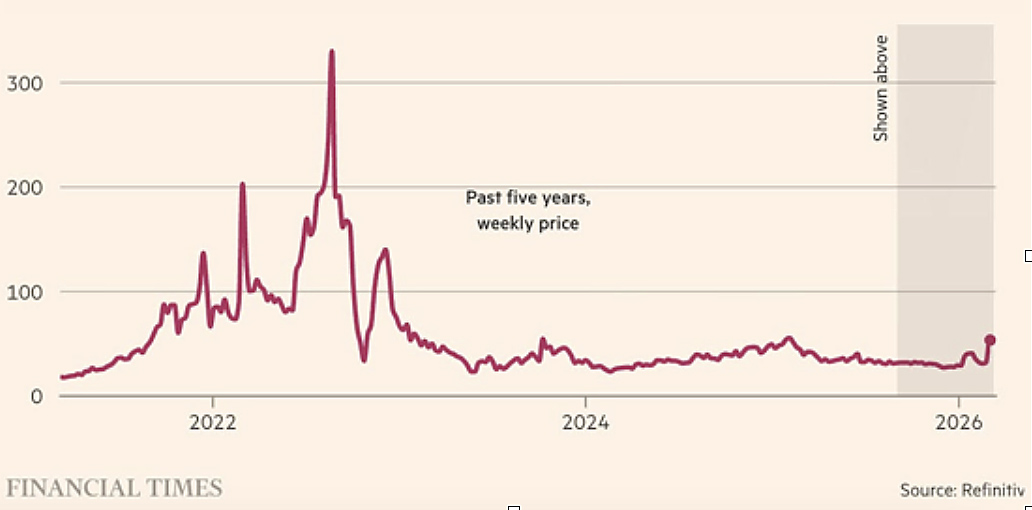
Middle East 2026 v Russia and Ukraine in 2022
|
|
|
|
But perspective is important – zoom out and we’re still a long way short of 2022 …
|
| |
|
|
| |
 |
|
| |
|
|
|
|
Asian Countries likely to be impacted more initially
|
|

|
|
Here’s the latest on home heating oil in Ireland
|
|

|
The vast majority of Iranian missiles & drones are being intercepted, but it comes at a cost. Stockpiles are dwindling and latest estimates put the cost of the war at $900m PER DAY for the US alone. The first 100 hours of the conflict cost a reported $3.7bn of which $3.1bn was spent on munitions.
Voters think that Trump is focused on the wrong things.
|
|

|
Does any of the above really matter in the long run?
Not according to history. The past is littered with geopolitical and economic events and while many of them matter in the short term, the fact that markets and economies ultimately march onwards and upwards is proof that all events are eventually consigned to history and people go back to doing what they have always done – innovate, solve problems and drive on the evolution of the global economy.
|
|

|
Future outcomes & events are nearly impossible to call. Let’s look back at the 2020’s so far, who would have predicted:
- Oil prices turning negative.
- Supply chain shocks.
- The fastest stock market crash and recovery in history.
- The strongest US labour market in a generation.
- A war breaking out in Europe lasting 4 years and still running.
- 9% inflation that wouldn’t lead to a recession.
- AI saving the economy with the release of ChatGPT right as inflation was peaking.
- The Tariff Tantrum following Liberation Day.
Volatility is always uncomfortable, but it should never be unexpected.
|
|

|
Investors will naturally be worried about the implications of current events and the danger of making a snap decision increases with noise. With that in mind, this week, I thought it would be useful to leave you with some thoughts that should be considered before making any decisions in relation to portfolios & investment holdings:
- Do you have confidence in predicting the outcome of the current situation?
- Can you reliably predict the implications for the markets?
- Are any of those implications likely to be material over your investment horizon?
- Is your investment portfolio diversified enough to cope with a range of possible outcomes?
- Have your investment objectives changed in any way?
Before considering a fundamental change, investors would be well served to consider the above questions and, in the absence of concrete answers, history suggests that sticking to the plan is usually the best course of action.
|
|
|
|